DRUGSTORE BEAUTY
How to Shop a Japanese Drugstore Beauty Aisle Without Reading Japanese
Matsumoto Kiyoshi, Sundrug, Welcia and Tsuruha are on every shopping street, and this is where most of the beauty items visitors ask about actually come from. The aisle looks impenetrable if you cannot read the packaging, but it is organised predictably and there are about ten words worth recognising.
How the shelves are arranged
Almost every store follows the same order, running from the entrance inwards:
- Seasonal display at the front — sunscreen in spring and summer, hand cream and lip balm in autumn and winter
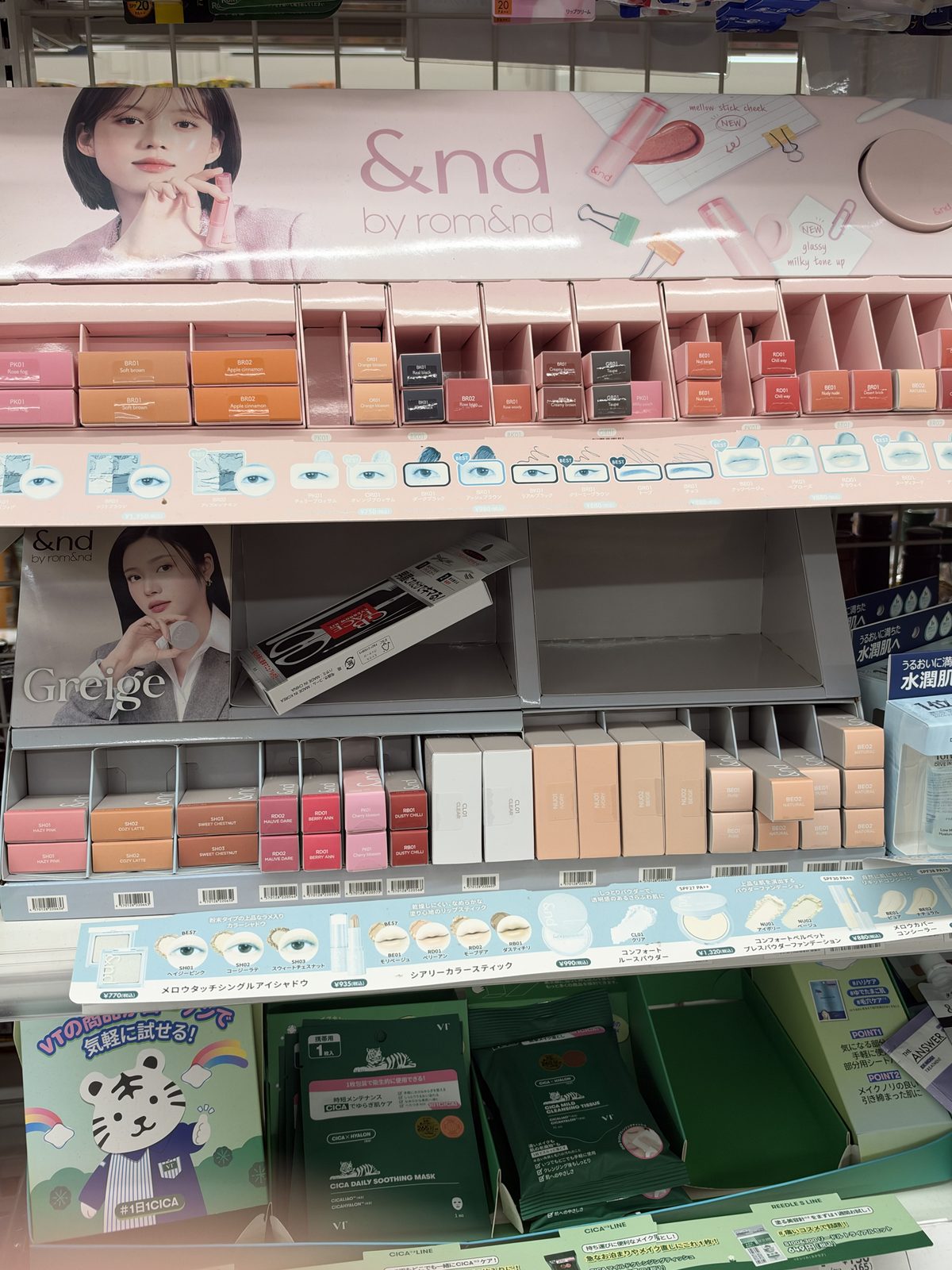
- Makeup, arranged by brand rather than by product type
- Skincare, arranged by brand and then by step
- Hair care, in the tallest bottles
- Body care and bath
- Medicines, usually behind a counter or at the back — not covered here
Skincare being arranged by step within a brand is the useful part: once you find the brand, the bottles sit left to right in the order you use them.
The package words to photo-translate
Point your phone camera at the label. These are the ones that tell you what a bottle actually is.
| On the label | What it is |
|---|---|
| 洗顔 / 洗顔フォーム | Face wash |
| クレンジング | Makeup remover, often an oil or a balm |
| 化粧水 | Toner or lotion — watery, used first |
| 乳液 | Emulsion — thin milk, used after toner |
| 美容液 | Serum |
| クリーム | Cream, the richest step |
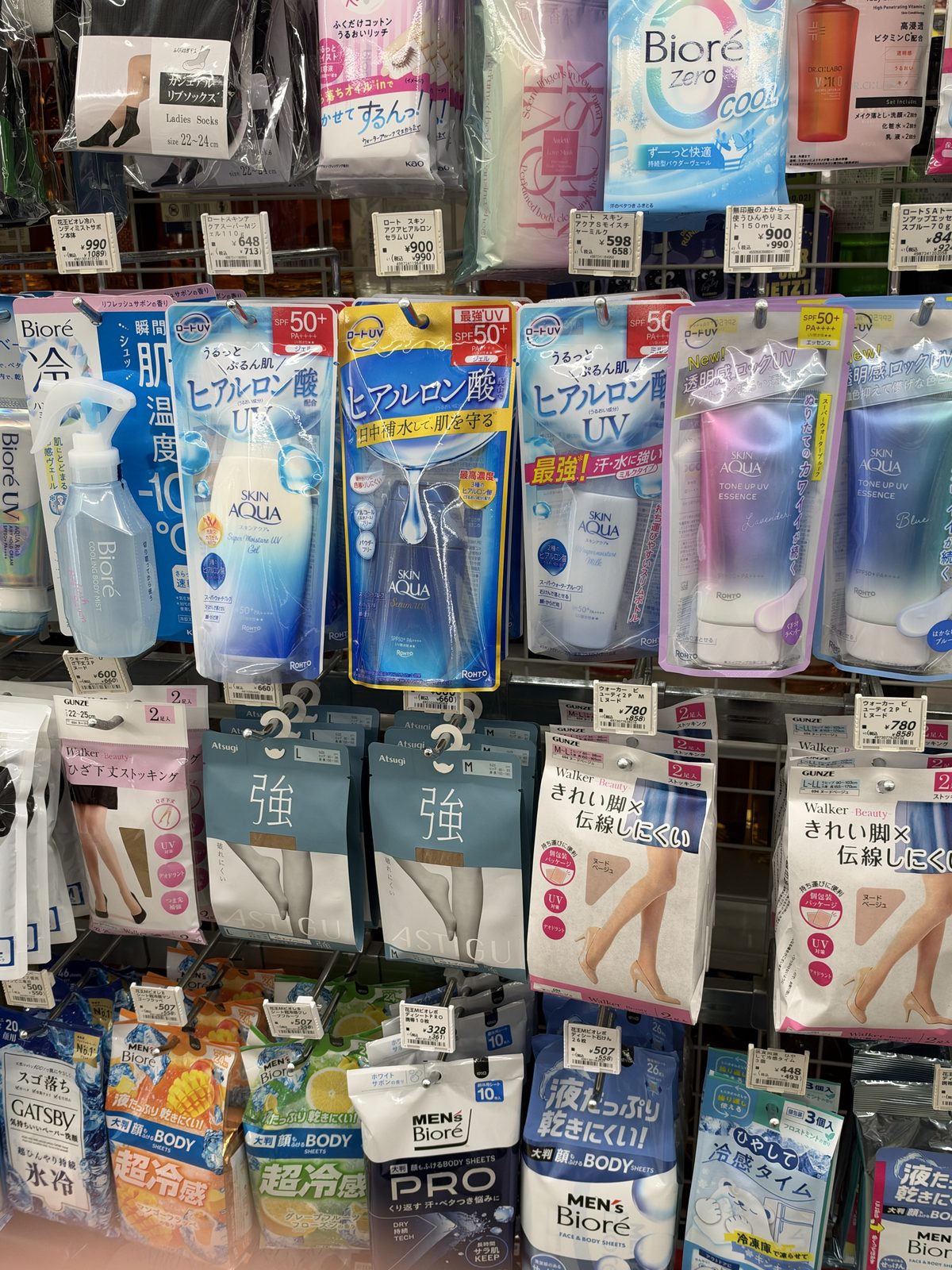
| 日焼け止め | Sunscreen |
| さっぱり | Light finish — the oily-skin version |
| しっとり | Rich finish — the dry-skin version |
| とてもしっとり | Richest version of the same product |
The last three are the single most useful thing on this page. Most Japanese skincare lines sell the same product in two or three finishes, and the only difference on the box is that word. If you have oily skin you want さっぱり; if your skin is dry you want しっとり.
Reading a label for dry versus oily skin
Beyond the finish word, three habits get you most of the way:
- Photo-translate the ingredient panel before you buy, not after. Ingredients are listed in descending order, the same convention used in the US, UK, Canada and Australia.
- Check the texture through the bottle. Japanese packaging is often semi-transparent. A watery liquid is a toner, a thin milk is an emulsion, a thick opaque one is a cream.
- Look at the size. Toners come in large bottles because they are used generously; serums come in small ones. A large bottle of something thick is usually a body product, not a face product.
If you have sensitive skin or a known allergy, patch test on your inner arm and wait a day before using anything new on your face. That advice is not specific to Japan, but the language barrier makes it easier to skip.
A four-step routine bought in one aisle
Cleanser, toner, emulsion and a simple moisturiser, all from the same shelf, come to roughly 4,000 yen or about $27 at 150 yen to the dollar.
- Cleanser (洗顔) — 500–900 yen
- Toner (化粧水) — 800–1,500 yen, and where the さっぱり or しっとり choice matters most
- Emulsion (乳液) — 800–1,500 yen
- Cream (クリーム) — 900–1,800 yen, optional if your skin is not dry
Buy travel sizes first if the brand offers them. Several lines sell a trial set of all four for around 1,000 yen, which is the cheapest way to find out whether a range suits you before committing to full sizes.
What to know about Japanese sunscreen before you buy it there
Texture, finish and price are the honest reasons to try a Japanese sunscreen. Many are lighter and less visible on the skin than what visitors are used to, and they are cheap.
What they are not is automatically better or safer for you. The United States regulates sunscreen as a drug, and the list of UV filters approved there is different from Japan's. FDA: Cosmetics importers The UK, Canada and Australia each run their own approval lists too. A filter that is normal in Tokyo may not be approved where you live, which is a regulatory difference, not a quality ranking. Treat a Japanese sunscreen as a preference, not an upgrade, and keep using it the way the label says.
Practical notes: PA+ through PA++++ is a Japanese rating for long-wave UVA protection and sits alongside the SPF number; sunscreen is a liquid, so anything over 100 ml goes in the checked bag; and the seasonal display at the front of the store is the cheapest place to buy it.
Picking a foundation shade
This is the hardest category to buy here and the easiest to get wrong.
- Shade ranges are narrow. Many drugstore lines carry three to five shades, clustered in light-to-medium with pink or yellow undertones. If your shade is outside that band, this is not the aisle for you.
- Testers exist but lighting is poor. Swatch on your jaw, not your hand, then step towards the front of the store or outside to look.
- Photograph the swatch in daylight and compare it with a photo of the foundation you already use.
- When in doubt, skip base products and spend on eyes and lips, where shade matching does not matter and the formulas are the part people actually come here for.
Sheet masks: how many and how to pack them
Multi-packs are cheap here and heavy in a bag, which is the whole tension.
- Price per sheet is the number to compare. A 30-sheet box at 1,200 yen is 40 yen a sheet, about 27 cents. A box of five at 500 yen is 100 yen a sheet. The large box is better value and much heavier.
- A 30-sheet box weighs roughly half a kilo. Two boxes is a kilo of your allowance for something you will use in a month.
- Buy one large box and one small box rather than three large ones, unless you know the brand suits you.
- Pack them flat in a zip bag inside the checked luggage. They are full of liquid and the seams do split under pressure.
Choosing hair products by texture, not brand
Oils, milks and creams sit in the same aisle in similar bottles, and the brand name tells you nothing if you cannot read it. Go by what is inside:
- Oil — clear, thin, usually in a glass or slim bottle with a pump. For smoothing and shine on dry ends.
- Milk — opaque and pourable, in a soft plastic bottle. The everyday leave-in.
- Cream or butter — thick, in a tub or a squat tube. For coarse or very dry hair.
- Mist — in a spray bottle. The lightest option and the one that does least.
Sizes are printed in millilitres, and the price is in yen on the shelf edge. Sachets of treatment masks, usually 100–200 yen each, are the cheap way to test a line before buying the tub.
Small buys under 800 yen
Under 800 yen, roughly $5.40, and small enough to finish on the trip:
- Lip balm, including the tinted ones
- Hand cream in a tube that fits a pocket
- Single sheet masks, sold individually near the till
- Hair treatment sachets
- Blotting paper
- Cuticle oil in a pen
- Powder papers, which are solid and have no liquid limit
Several of these are findable in the US, UK, Canada and Australia through importers, usually at two to three times the price. That is the honest reason to buy them here rather than a claim that they cannot be had at home.
We do not cover Japanese medicines
Painkillers, eye drops, stomach remedies and cold medicine sold in Japanese drugstores can contain ingredients that are not approved where you live, and importing them can be restricted. This site does not recommend buying them to take or ship home. If you need medication while travelling, speak to a pharmacist at the counter or to a doctor.
Get the free printable shopping list
Next: konbini snacks and prices and 100-yen shop finds. If the trip is not booked yet, where to stay and when to go comes first.